DossierBehind the Novels
Types of Ciphers: From Caesar to Kryptos in Dan Brown's Novels
A Roman general shifting each letter three places down the alphabet, a Hebrew scribe reversing the alphabet, a Masonic lodge drawing letters as fragments of a grid, a future president designing a wheel of lettered disks, a sculptor cutting an encrypted message into a copper screen outside CIA headquarters: the history of ciphers is a history of people trying to keep secrets, and of others trying to break them. This section gathers the blog's articles on the types of ciphers that appear in thrillers, with how each one works in principle, where it comes from and how Dan Brown and the other novelists of the catalog use it.
Why ciphers matter to thriller readers
Ciphers are the puzzles at the heart of the conspiracy thriller. Dan Brown's Robert Langdon solves an Atbash inscription and opens a cryptex in The Da Vinci Code, deciphers a Masonic grid in The Lost Symbol and lives in a world where codes are left by the dead for the living. Ken Follett built The Key to Rebecca on a real wartime book cipher, and Brad Meltzer built The Book of Fate on a code attributed to Thomas Jefferson. The same ciphers turn up in spy novels, where the stakes are not a treasure but a life.
Most of the ciphers used in these novels are historical, simple enough to be explained on the page and broken long ago. That is part of their appeal: the reader can follow the solution. The articles below explain how each one works in general terms, who used it and when, and which novels put it on the page.
Codes and ciphers: the difference
The two words are often used as if they meant the same thing, but cryptographers distinguish them. A code replaces whole words or phrases with other words, numbers or symbols drawn from a codebook; a cipher works on the letters themselves, substituting or rearranging them according to a rule and a key. The Zimmermann telegram of 1917 was sent in a numerical code; the messages of Caesar, the Vigenère square and the German Enigma machine are ciphers. A book cipher sits in between, using a shared book as its key.
A short history of ciphers
The oldest ciphers simply replaced one letter with another. The Roman historian Suetonius records that Julius Caesar shifted the letters of his private messages, and the Atbash cipher, which reverses the Hebrew alphabet, appears in the text of the Bible. Such substitution ciphers were broken by frequency analysis, which Arab scholars described as early as the ninth century: in any language some letters are more common than others, and the pattern survives the substitution.
The answer of the Renaissance was the polyalphabetic cipher, which changes the substitution from letter to letter according to a keyword. The cipher now named after Blaise de Vigenère was long called unbreakable, until nineteenth-century cryptanalysts, among them Charles Babbage and Friedrich Kasiski, showed how to attack it. Cipher devices followed, from Jefferson's wheel of the 1790s to the electromechanical machines of the twentieth century, such as the Enigma, whose breaking at Bletchley Park is one of the great stories of the Second World War.
The articles on types of ciphers
The articles are grouped by family. Each line says what the article explains.
Substitution Ciphers
- Caesar Cipher: the shift cipher described by Suetonius, how it works in principle and where it appears in Dan Brown's novels, including Digital Fortress.
- Atbash Cipher: the Hebrew cipher that reverses the alphabet, and the inscription it unlocks in The Da Vinci Code.
- Pigpen Cipher: the grid cipher associated with the Freemasons, and the scene in The Lost Symbol that uses it.
Polyalphabetic Ciphers and Cipher Devices
- Vigenère Cipher: the cipher once called unbreakable, how it was broken and its place in code thrillers and in the Kryptos sculpture.
- Jefferson Wheel Cipher: the device Thomas Jefferson designed, how it worked and the Brad Meltzer novel built on a Jefferson code.
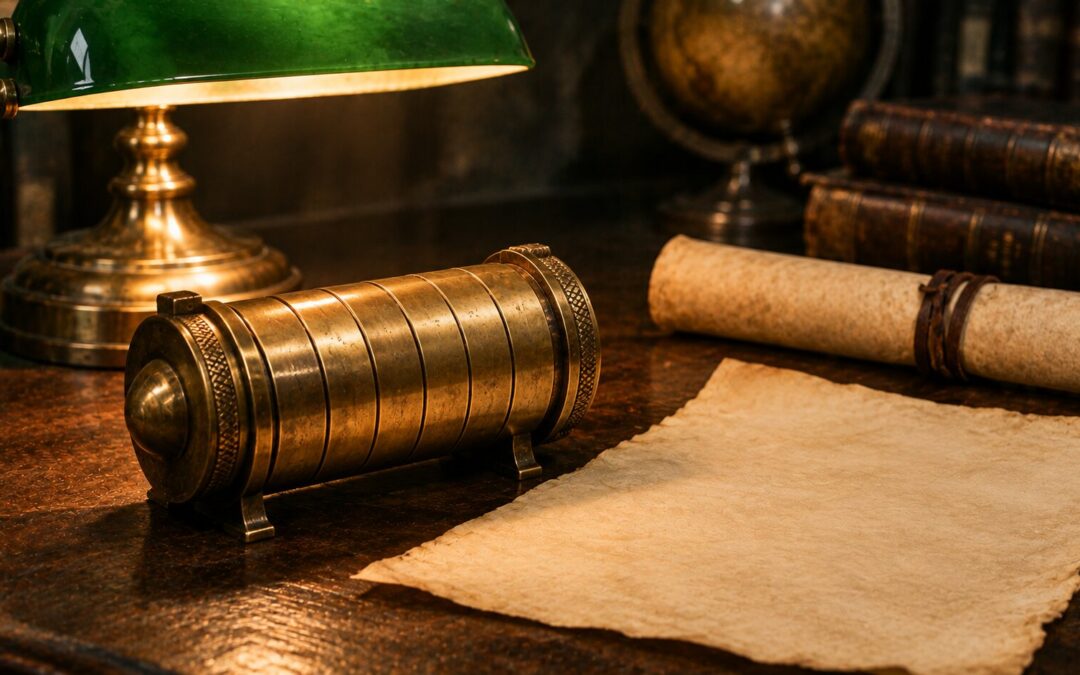
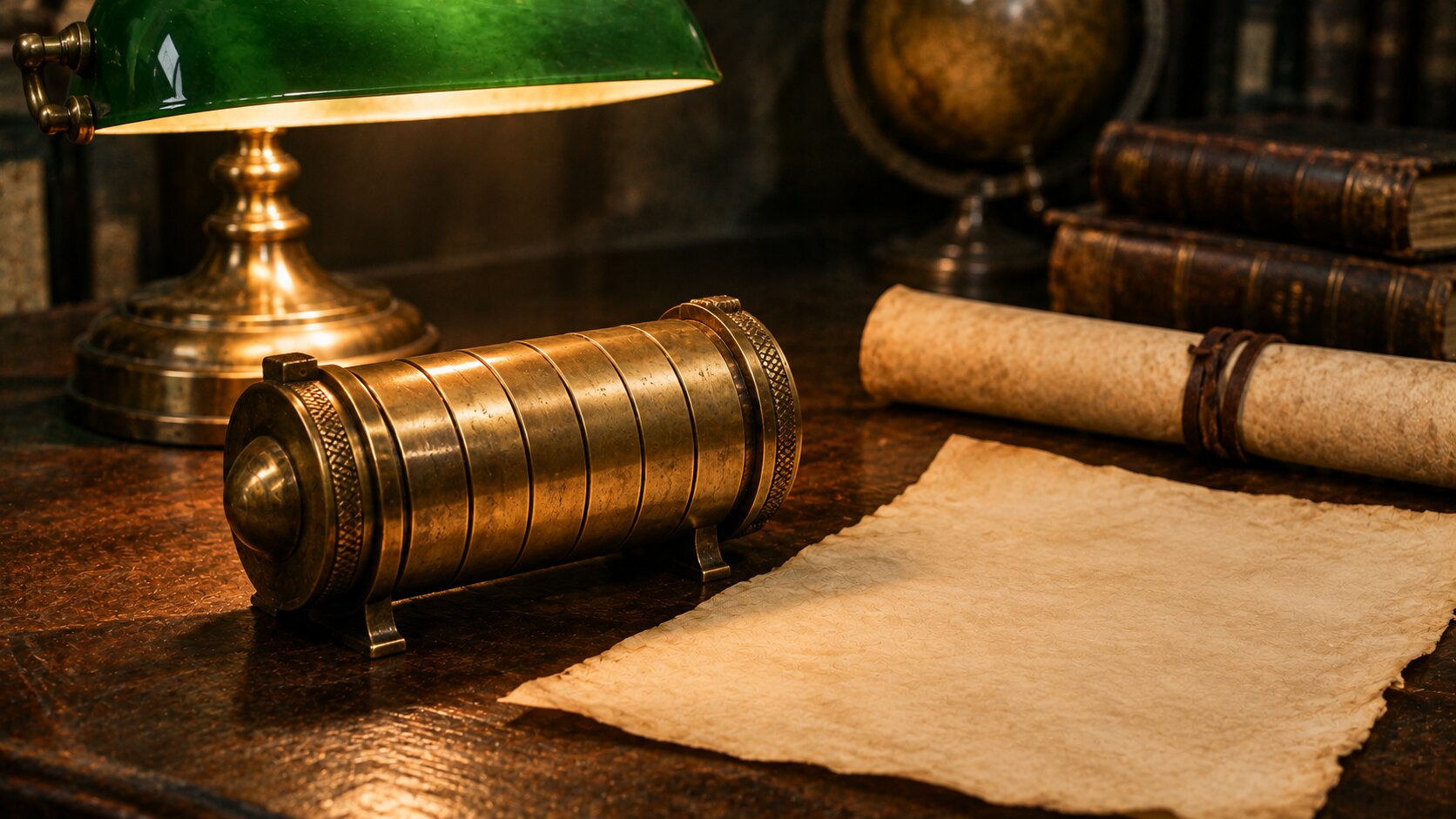
- Cryptex: the device Dan Brown created for The Da Vinci Code, and where the idea comes from.
Codes Hidden in Books and Sculpture
- Book Cipher: the cipher that uses a shared book as its key, from Benedict Arnold's letters to the real wartime case behind Ken Follett's The Key to Rebecca.
- Kryptos: the sculpture at CIA headquarters, what has been solved and how Dan Brown's novels refer to it.
Kryptos: the cipher outside the CIA
No modern cipher has drawn more amateur codebreakers than Kryptos, the sculpture by Jim Sanborn installed at CIA headquarters in Langley, Virginia, in 1990. Its copper screen carries four encrypted passages. Three were solved in the 1990s, by analysts at the NSA and the CIA and independently by a computer scientist. The fourth resisted for decades; in 2025 its plaintext was found among the sculptor's papers in a Smithsonian archive, discovered rather than cracked. Dan Brown has referred to Kryptos more than once, most visibly in the hidden coordinates on the jacket of The Da Vinci Code and in The Lost Symbol.
The novels of the catalog built on ciphers
These are the books the articles above refer to most often. The links lead to the catalog pages, with reading orders and publication details.
The Robert Langdon series, Dan Brown
Ciphers in every novel, from the Atbash and the cryptex of The Da Vinci Code to the Masonic grid of The Lost Symbol.
Digital Fortress, Dan Brown
Brown's first novel, set among the codebreakers of the National Security Agency.
The Key to Rebecca, Ken Follett
A German spy in wartime Cairo who encrypts his messages with a novel as the key, a method taken from a real case of 1942.
The Book of Fate, Brad Meltzer
A political thriller in Washington built around a code attributed to Thomas Jefferson. The Brad Meltzer page lists his other novels.
The Rose Code, Kate Quinn
Three women at Bletchley Park and the codebreaking of the Second World War, for readers who want the machines rather than the puzzles.
The Political Thrillers genre page gathers the conspiracy thrillers of the catalog. The secret societies whose symbols these ciphers protect in fiction have their own index in secret societies.
Where the facts come from
The articles rely on the history of cryptology as told by the institutions that practiced it and the museums that preserve it. Useful sources are the CIA's page on the Kryptos sculpture, the Thomas Jefferson Encyclopedia at Monticello on the wheel cipher and the National Cryptologic Museum's exhibit on the eighteenth-century cipher device. The articles explain principles, not methods for breaking modern systems.
Part of Behind the Novels
This index is one of the sections of Behind the Thriller Novels, the blog's guide to the codes, agencies and tradecraft behind spy and conspiracy fiction, where the sections on spy terms and secret societies are also listed.
Frequently asked questions
What are the main types of ciphers?
The main families are substitution ciphers, which replace each letter with another (the Caesar, Atbash and pigpen ciphers); transposition ciphers, which rearrange the letters; polyalphabetic ciphers, which change the substitution according to a key (the Vigenère cipher and devices such as Jefferson's wheel); and machine ciphers such as Enigma. Book ciphers use a shared text as their key.
Has Kryptos been solved?
The first three passages were solved in the 1990s. The fourth was never broken by cryptanalysis; in 2025 its plaintext was found among the sculptor's papers in a Smithsonian archive. The Kryptos article explains what is known and what remains uncertain.
Which thrillers use real ciphers?
Dan Brown's Robert Langdon novels use the Atbash and pigpen ciphers and refer to Kryptos, Ken Follett's The Key to Rebecca is built on a real wartime book cipher, and Brad Meltzer's The Book of Fate on a code attributed to Thomas Jefferson.